Reflections on Training
This week I just want to talk a little about how games are used in different ways and some of my experiences in training and cross-training acting and improvisation!
I got a really cool comment on Games for an Ordinary Life , my art zine of minimalist games, over on itch.io.
(I assume the commenter ‘Eudyptes13’ got my game from the No ICE in Minnesota charity bundle, which has raised over $500k for the Immigrant Law Center of Minnesota. If you can, go support it and get over 1,400 games and tools for as low as a $10 donation to help out the cause.)
Eudyptes found two games I wrote, The Mightiest Dragon and (Un)Fortunately Fate, and they’re going to add them to their library of games for a self-defense class to help work on de-escalation and cognitive agility. Go read the comment, because I think this is super cool! These games are slight expansions of improv and acting warmups, and one strong layer of their purpose is to exercise and stretch specific skills and mental muscles.
The Mightiest Dragon is a memory repetition game that asks you to think of creative descriptions for why you’re the mightiest dragon, and the roleplaying and storytelling element comes in when you forget one: you have to describe how that feature was your hubris and caused your downfall.
(Un)Fortunately Fate is vaguely about dramatic structure and using successes and failures within the framework of the improv warmup game 'Fortunately, Unfortunately', but that one is very formulaic, so in this version you flip a coin to break the predictable rhythm, plus a very small collective decision making practice to distribute a resource at the end of each round.
I think it’s really cool to use warmup games not just to get the body and mind moving but in targeted ways to focus on warming up and exercising specific skills. I recently used The Mightiest Dragon with my long form improv team Marge, which performs a monoscene form (meaning our set has no edits) as a memory exercise, because sometimes remembering things like 'the names of characters' over a high-energy 25-minute set can be hard. Eudyptes sees potential in these games to help with mental agility in confrontational situations, and I’m very eager to hear how the tools work out in their class.
I find it's super important to train for purpose in performing arts. I think it's not enough to just have the skills trained, but it's important to connect them to the specific activity you want the skills accessible in. I’m an accomplished actor and improviser, but I can imagine myself freezing mentally in a confrontation because I haven’t trained it. There is a very specific brain-body connection that needs to be built and worked over and over in order to make skills – especially speed-of-thought skills like we find improv, acting and self defense – accessible in those heightened moments. You can have practiced something out of context and then loose it when you’re in the stream of the moment.
I routinely experience this disconnection in two ways myself. When I'm learning an new improv or acting exercise, especially one that’s technical or speaks to a skill of mine that’s underdeveloped, I have a myopic sensation where it feels like my other training falls away like a shed skin and I cannot or forget to access them — the scenes aren’t “good” from the inside perspective, they’re wooden-feeling, process oriented experiences. It’s only after repetition, when the connection is made and strengthened, that I feel it integrating in a more comfortable way.
The second place I feel this disconnect is between my acting tools and my comedy improvisation. They’re both performance work and they both engage with storytelling and improvisation. I think they can be mutually supportive — and I do gain benefit but not as much as I’d like. On stage while performing comedy improv, I often don’t have time and wherewithal to access some of my deeper acting tools despite how strong they are in my scripted work! The two approaches are distinct enough that it takes conscious cross-training effort to make them accessible. The speed of comedy improv and the number of things taking over the brain make it so that if I haven’t set something up for that context yet, it’s usually harder for me to find it in the stream of the work.
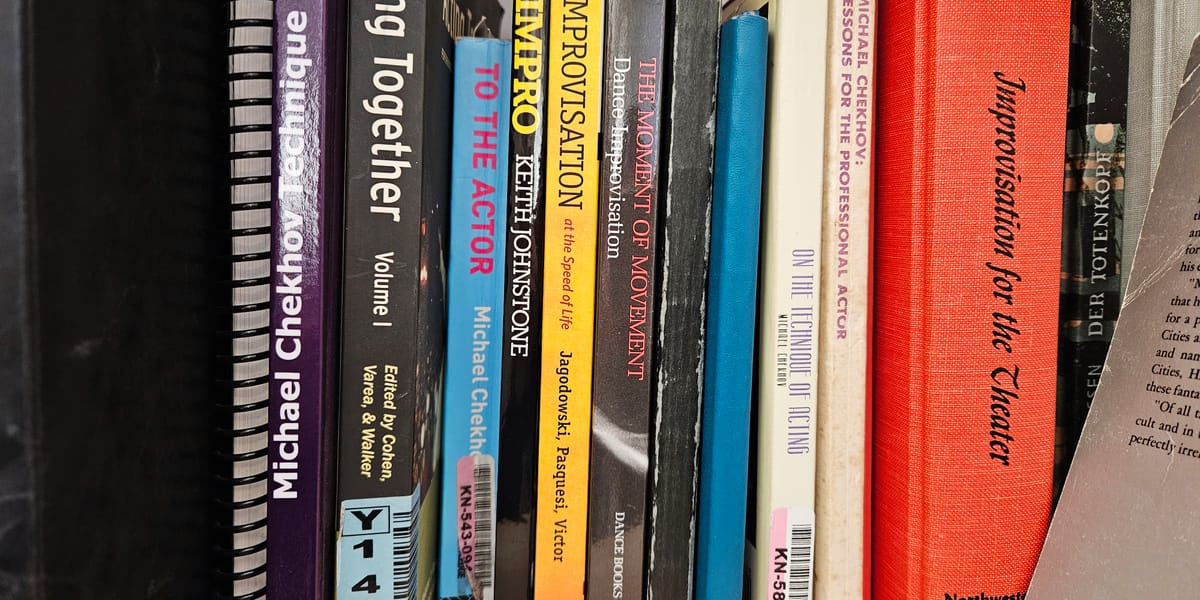
This makes a lot of sense when I think about how my acting tools work. I’m most deeply trained in the Michael Chekhov technique, which is — very briefly — an extensive toolbox rooted in physical movement and imagination. The tools provide a strong basis to construct a performance from, but a final embodiment of a character is more than implementing preformed choreography. The preparation is kind of like a skeleton. Another way of thinking about it is that acting is trying to portray some aspect of life by taking what we expect to be a subconscious inner life of a character, exploring it consciously and then showing it as if it were the subconscious again. You have to take the subconscious up to the conscious level if you want to really develop in an artistic way, and then let it settle somewhat back in the subconscious.
This requires focused repetition of exercises to develop different layers of the character and performance. When applied properly, they’re incredibly strong tools — but they have to be applied. Just because I’ve practiced the tools doesn’t mean they’re fully accessible in a novel context. I benefit most strongly from the muscle memory of stagecraft and voice training, but even some parts of that (like making good stage pictures) can fall away in the speed and headiness of our particular style of long-form comedy improv.
Another place I’ve encountered benefits of cross training, but only from the outside as a teacher and not a practitioner, is in my exploration of teaching Chekhov technique for sex workers. Some sex workers do view their work in some way as a performance in which they play a type of character. There’s a lot to say on how to play characters that are very close to you — it also comes up when you have an autobiographical work or any other performance where the character is a version of yourself. There are many practices you can use to separate and protect the private self from the character (and from ‘bleed’ as we call it in the ttrpg space). And in Chekhov technique there are many tools for holding space between performer and audience, connecting with and responding to partners, among others.
One great success in the workshop for sex workers was that in each session during feedback moments, at least one person would share that an exercise we did was very similar to something they would do with clients or for themselves already. This, to me, is a great sign that these tools are relevant if they’re matching organic discoveries and helping people to find broader connection to their self-developed technique. The cross-training strengthens them along several axes.
I don’t have a deeper conclusion aside from just being able to say that I think training and exercises with focus and purpose are so important in our work and sometimes don’t get enough attention. I feel it in some of my improv practice: we'll do full length sets to get used to spending that time on stage, but we don’t deconstruct them in enough different ways. I also feel the lack of training and preparation in the Actual Play world — most streams I’ve performed on have been with at least one complete stranger to me and have had no rehearsal and no true preparation to align styles, to learn the intricacies of what are sometimes new game systems, and get build ensemble feeling. And no, a session 0 or .5 is not a solid preparation! I think it’s a weakness in how we approach the form. I think it would do us benefit to slow down in order to learn to play better together.
Finally, my great gratitude to Eudyptes for not only donating to the bundle, downloading my little zine and reading it, but also sharing their thoughts with me which has triggered this reflection training.
If you don’t have Games for and Ordinary Life, you can get a digital copy directly from my itch page or you can support the No ICE bundle and get that and a bunch of other amazing games as well. If you don’t buy directly from me, please consider supporting me for a month or two here.