Step into Story: Immersive worldbuilding through play
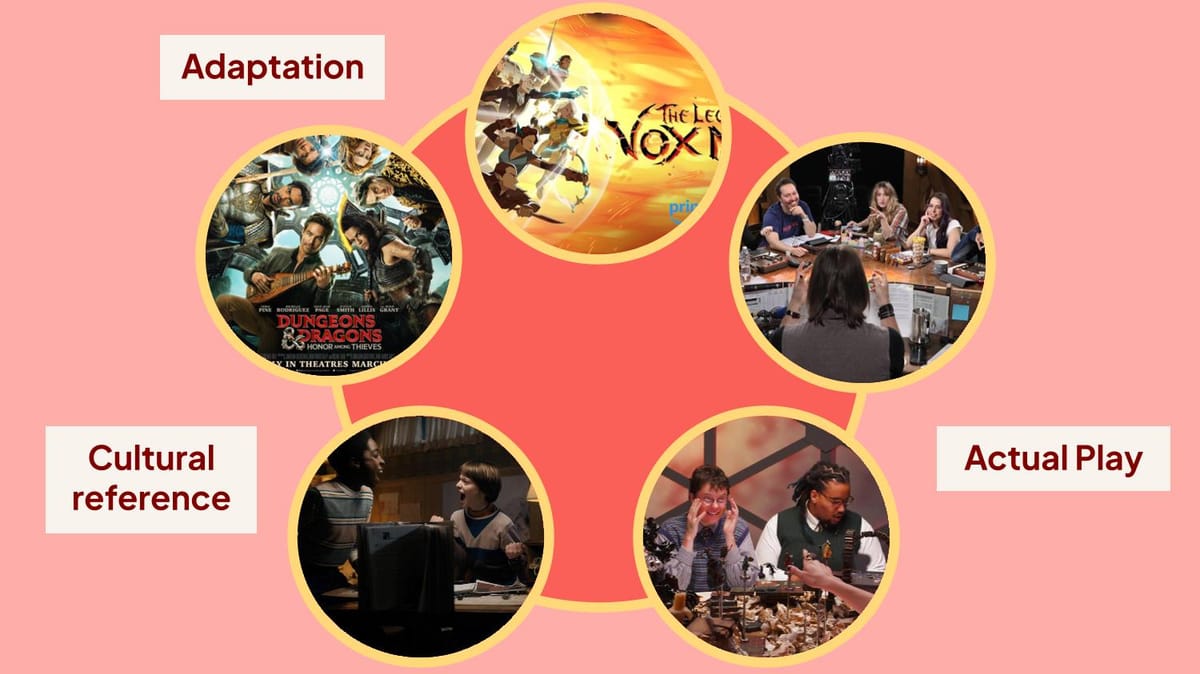
A couple weeks back, I got to give a workshop called “Step into the Story: Immersive worldbuilding through play” at the Seriencamp conference (a series festival, like a film festival but for series) on the subject of using roleplaying games in the writers’ room.
It’s not a unique thought — other people like Lin Codega writing for Rascal have also shared the idea in their article A Writers Room is a Tabletop Game. I even had the opportunity to check in and validate my ideas with Lin in my prep and research for the event. We generally agreed on the points, but there's room for discussion ;-)
The workshop was a smashing success! The room was half-full, which fit my needs perfectly. In one hour, I gave a theoretical framework and we played a game with about 25 people in the room together. People came up to me for the entire rest of the day to share how insightful they thought it was, so that’s a success!
My basic pitch was that roleplaying games are collaborative storytelling tools and genre engines. This isn’t really news to us, but I think it’s important to understand that they’re seen as games and not taken seriously. One core idea I offered as a counter-narrative is that while screenwriters are masters of their craft of telling a very specific story for an audience and telling it in a well structured way, game designers are also masters of their craft, giving people the tools to tell genre stories with each other. In one sense, it is two sides of the same coin.
What caught me off guard was how many of the writers I talked to were surprised at the array of tools we have in roleplaying games that are designed to really hold character and help us make constrained decisions. Pick lists and tables are useful and inspiring material and good prompts are provocative and generative if well developed. GM tools are great for organizing characters, relationships and plot details. I think I was surprised by their astonishment because I usually anticipate that roleplaying games aren’t taken seriously by many professional writers and that likely leads to me subconsciously devaluing them—but the reality is that yes, we should hold them as highly prized storytelling tools, because they are well crafted story engines, and there’s a constant pressure to invent new tools that are getting better all the time!
Anyway, I’m delighted by lenses that break down walls between disciplines. Yes, if you look at it in one way, a writers’ room is a tabletop game! Just with its own well defined adaptation of the outputs. Don’t get me wrong, I do not believe you can go from ‘good tabletop player’ to ‘good series writer’ without honing an additional full-on craft or two. But they exist in the same fundamental soup—telling good stories with strong characters. Playing and learning how roleplaying games work can offer you useful tools as a writer.
This was a great experience and generated some good connections for me. I’m looking forward to continuing this work. It’s in the same direction as many of my other projects, and I’m excited to keep finding ways to bring them together. I owe many thanks to Gerhard and Marvin for believing in this session, and I hope to expand on this work in the near future!
If you’re working in a writers’ room or teaching writers and you want to hear more, please reach out! I’d love to chat and see how I can support your work.
And if you don’t know my work, check out The Witches of Wederra Keep, my award-winning witchy actual play podcast, or see me perform live fantasy roleplaying improv comedy with Tales Held Dear in Berlin!